Overview
Yahoo Games was reintroduced as a modern destination within Yahoo, bringing casual and daily games back into the ecosystem after years of fragmentation.
I led design across two major phases: an initial fast launch under the Search organization, followed by a system-driven refresh that aligned Games with Yahoo’s evolving design platform. This work focused on building momentum first, then creating foundations that could scale.
Overview
Yahoo Games was rebuilt and relaunched as a modern destination within Yahoo after years of fragmentation. The initial phase prioritized speed, with an external agency executing much of the build while I partnered closely from the Yahoo side to shape direction and consult on core experience decisions.
Following launch, I led the next phase of evolution: stabilizing the product, aligning it with Yahoo OS, a newly evolving cross-platform design system, strengthening discovery, and addressing structural consequences of a fast rollout. During this period, we were operating without a dedicated product manager, requiring close collaboration with engineering and expanded ownership over prioritization, scoping, and execution planning.


Initial Yahoo Games launch in 2023
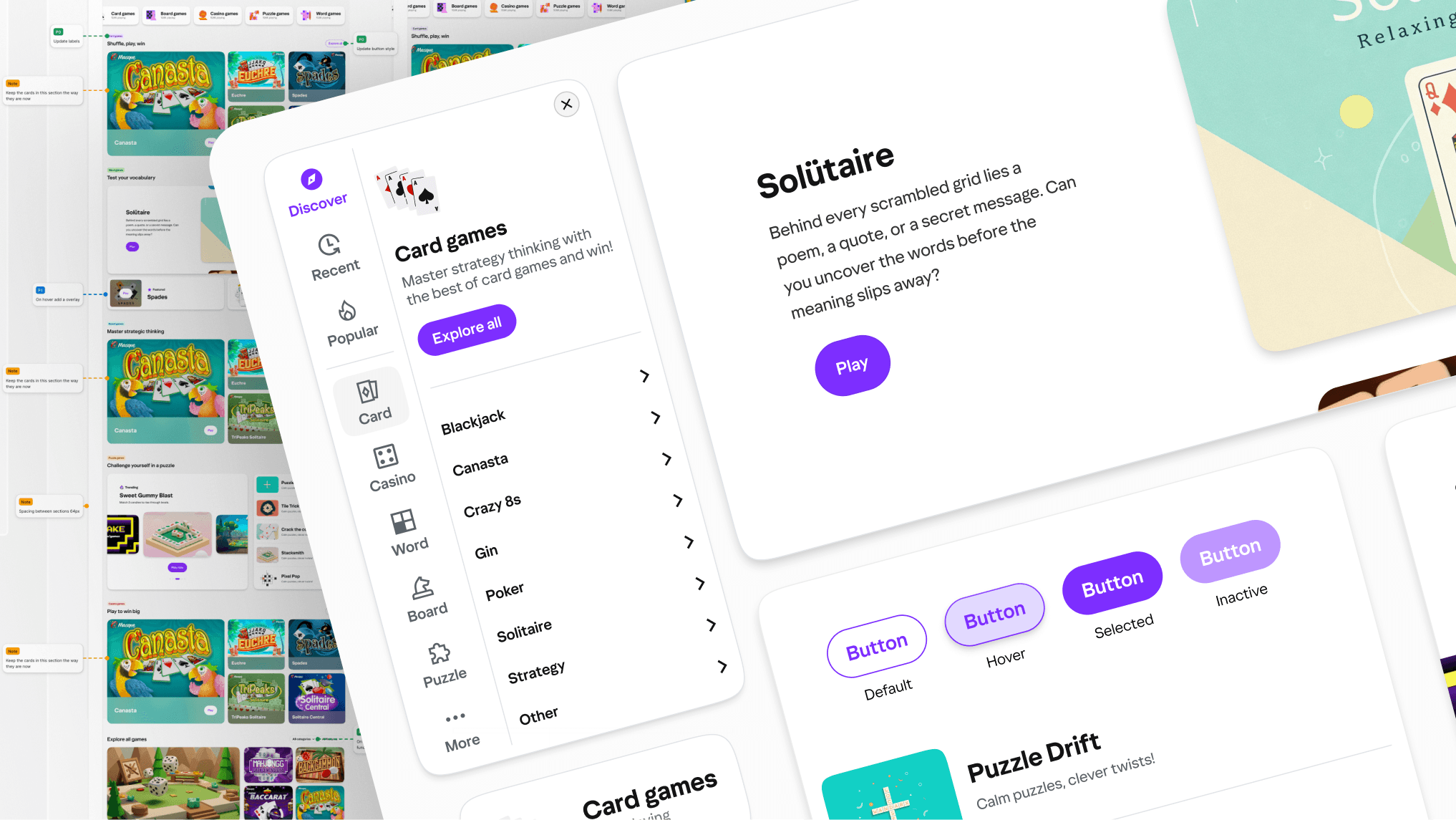

System update in 2025


Initial Yahoo Games launch in 2023


System update in 2025
Yahoo Games was rebuilt and relaunched as a modern destination within Yahoo after years of fragmentation. The initial phase prioritized speed, with an external agency executing much of the build while I partnered closely from the Yahoo side to shape direction and consult on core experience decisions.
Following launch, I led the next phase of evolution: stabilizing the product, aligning it with Yahoo OS, a newly evolving cross-platform design system, strengthening discovery, and addressing structural consequences of a fast rollout. During this period, we were operating without a dedicated product manager, requiring close collaboration with engineering and expanded ownership over prioritization, scoping, and execution planning.

Initial Yahoo Games launch in 2023

System update in 2025

Initial Yahoo Games launch in 2023

System update in 2025
Initial Yahoo Games launch in 2023


Problem Framing
User Challenges
The initial launch delivered speed, but as the portfolio expanded to include new first-party and third-party games, visual styles and discovery pathways risked becoming fragmented. Users needed clearer entry points and a more cohesive experience across surfaces.
Business Opportunity
Yahoo had the opportunity to grow Games into a habit-forming destination within its broader ecosystem. To support long-term growth, the product needed stronger platform alignment, clearer visual direction, and improved distribution beyond the Games channel itself.
Problem Framing
User Challenge
The initial launch delivered speed, but as the portfolio expanded to include new first-party and third-party games, visual styles and discovery pathways risked becoming fragmented. Users needed clearer entry points and a more cohesive experience across surfaces.
Business Opportunity
Yahoo had the opportunity to grow Games into a habit-forming destination within its broader ecosystem. To support long-term growth, the product needed stronger platform alignment, clearer visual direction, and improved distribution beyond the Games channel itself.
Contraints
A newly evolving cross-platform design system (Yahoo OS) rolling out in parallel
Mixed visual styles across first-party and partner games
Tight iteration timelines following launch
No dedicated product manager during the system alignment phase
Cross-functional dependencies with marketing, brand, and engineering
Key Decisions & Tradeoffs
Reintegration Over Visual Fragmentation
As Games evolved, we debated whether the product should feel expressive or minimal. Early explorations leaned into higher-energy and nostalgic cues, while Yahoo OS emphasized a cleaner, modern system. Competitive references like The New York Times Games introduced additional pressure toward restraint. Rather than allowing Games to drift toward either extreme, I advocated for reintegration into the Yahoo ecosystem. Shared UI, navigation, and metadata aligned with Yahoo OS standards, while personality was introduced selectively within game surfaces.
Tradeoff: We constrained system-level visual expression to achieve long-term cohesion and scalability across the ecosystem.


Establishing Boundaries Between Gameplay Energy and Platform Consistency
The portfolio included highly cartoony third-party titles alongside emerging first-party experiences like Quiz. Without intentional structure, the ecosystem risked feeling visually inconsistent. I developed and presented a framework evaluating game art styles, dialogue patterns within gameplay, and competitive benchmarks. This work informed style guide discussions with our external brand agency and shaped visual direction for Yahoo Trivia.
Rather than forcing uniformity, I defined a layered model:
Gameplay surfaces could maintain distinct energy
Shared navigation and system UI remained consistent
Brand personality lived in controlled accents
Tradeoff: We preserved variation without sacrificing platform cohesion.


System Stress Test
Scaling Quiz Within An Incomplete Foundation
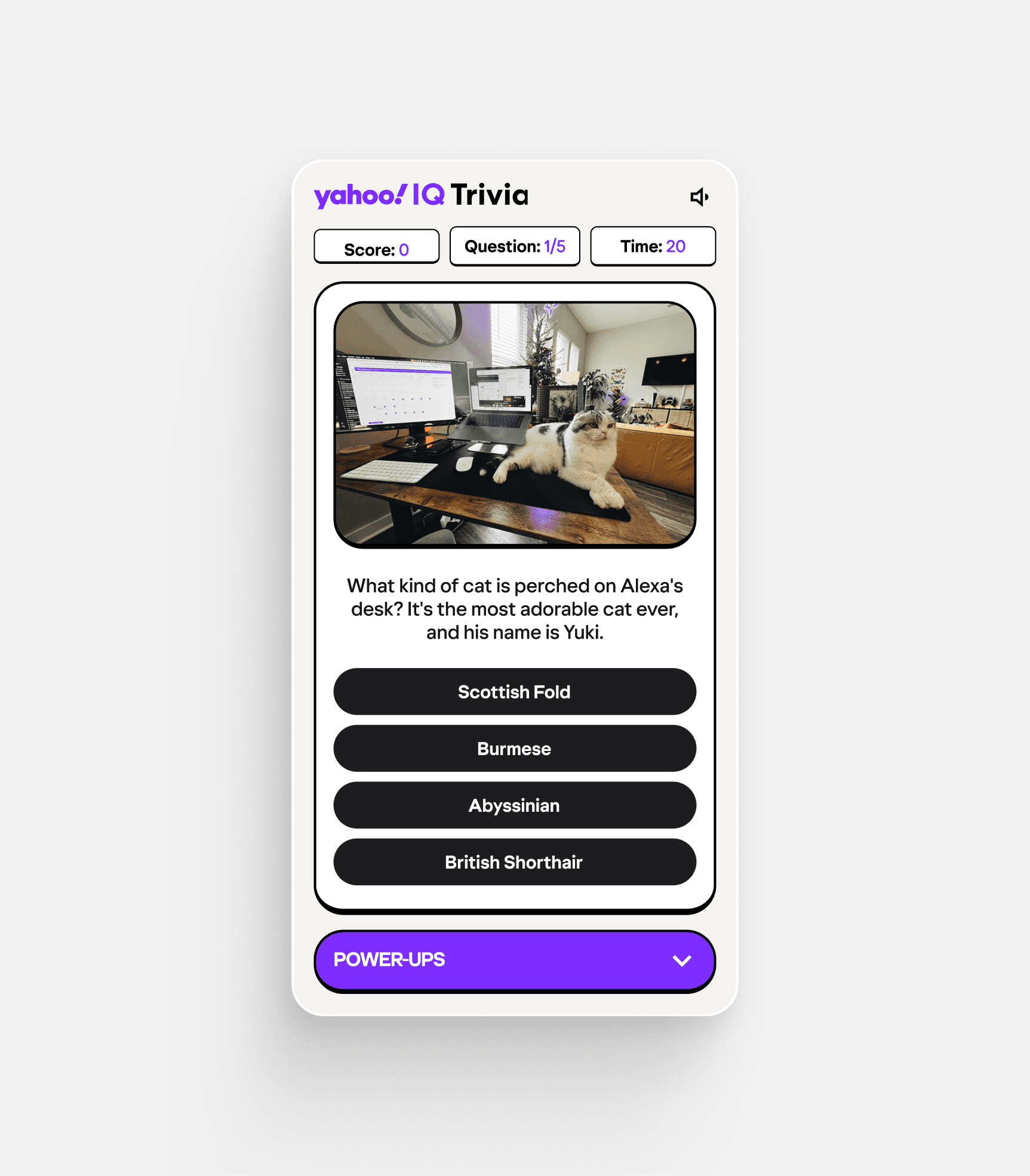
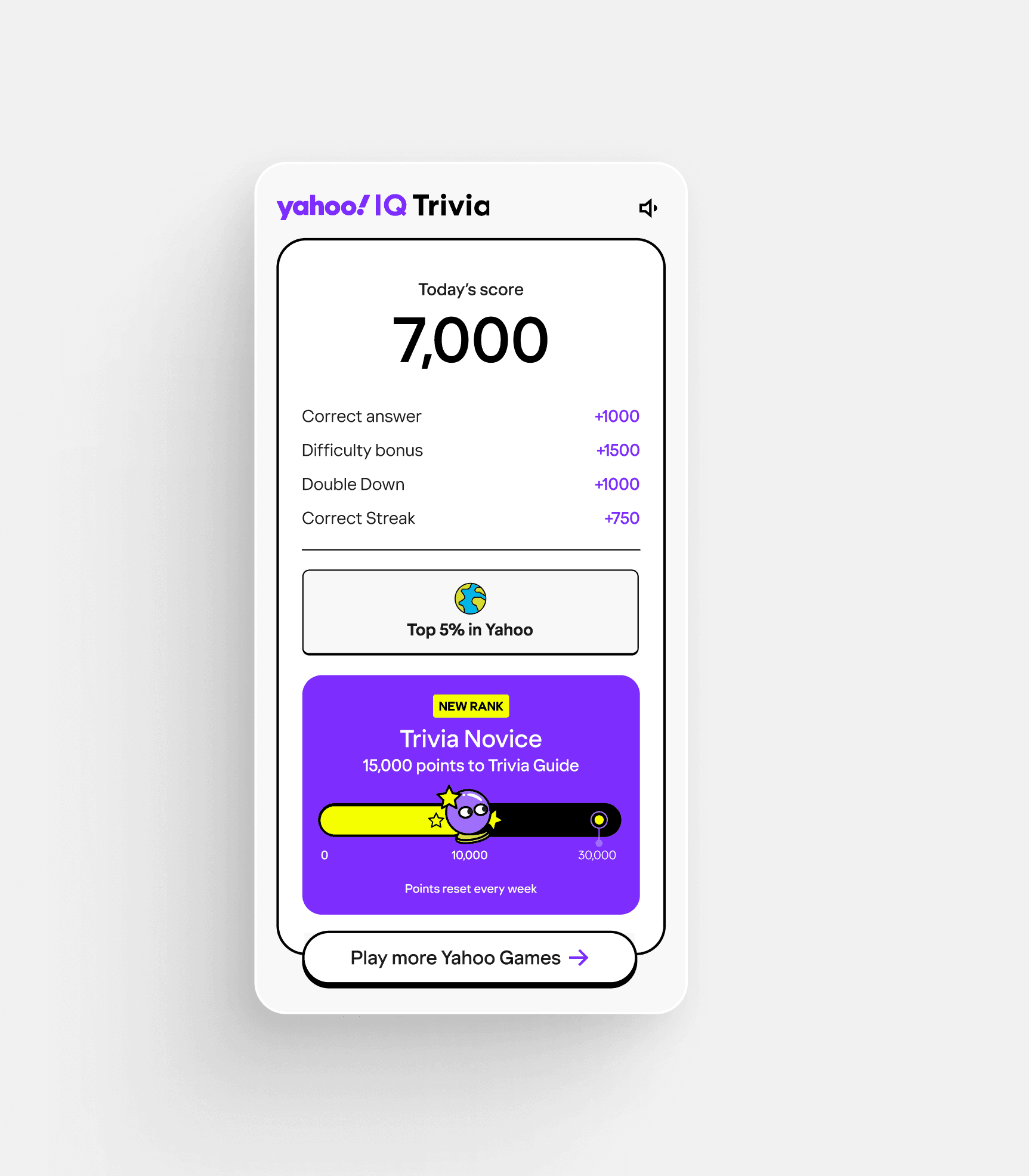
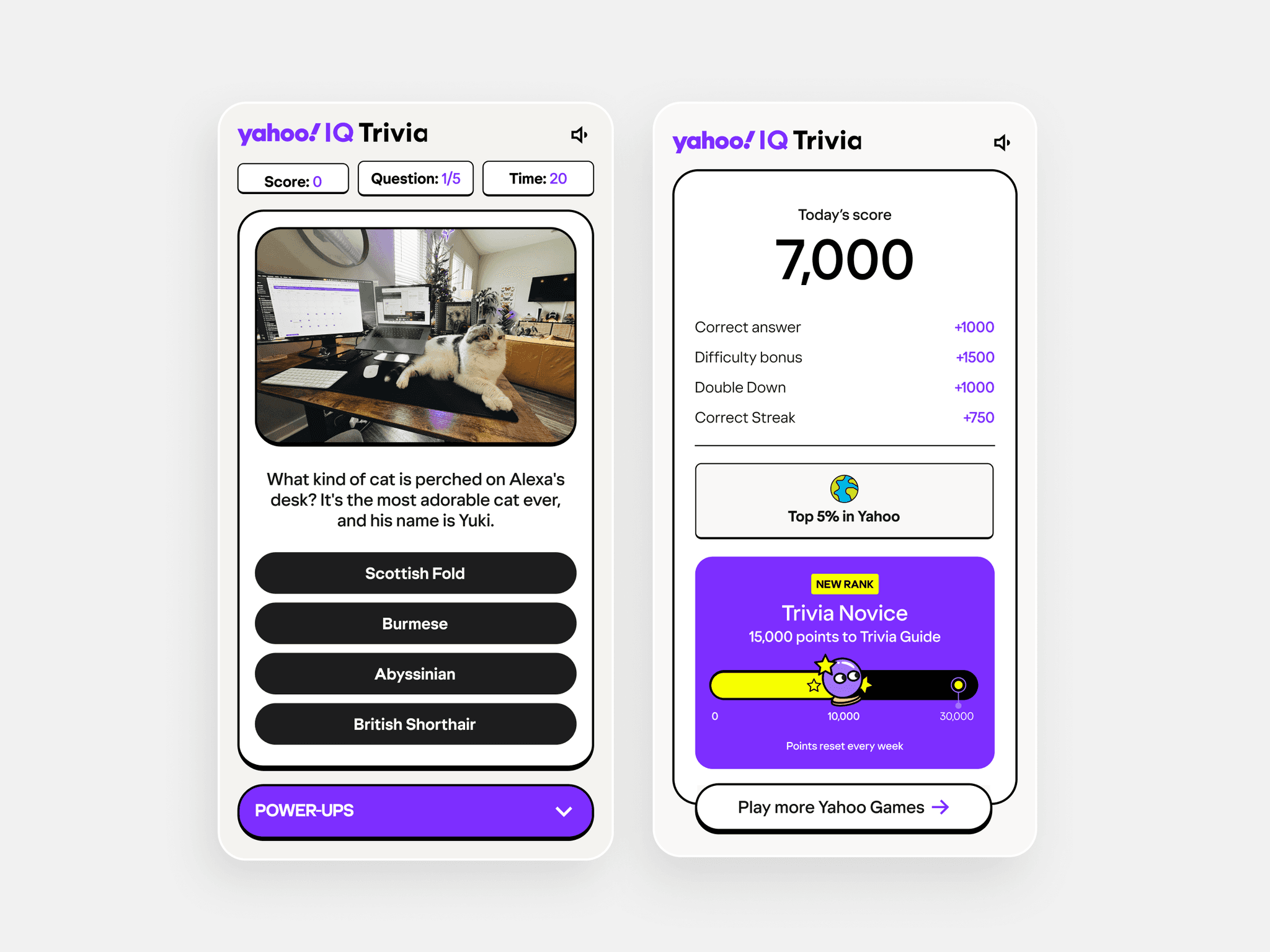
As part of expanding first-party experiences, we launched an embedded Quiz directly on the Yahoo homepage. The initial build was created from two directional creative mocks, one desktop and one mobile, which a third-party team translated directly into a rigid tool builder. While this enabled speed, it did not account for full user flows, edge cases, or responsive behavior across devices.
As additional screens and real usage patterns emerged, the limitations became clear, particularly on mobile. Within significant architectural constraints and tight timelines, I rebuilt the full Quiz experience across screens and refactored the mobile system to properly support responsiveness while remaining compatible with the original infrastructure.
This required designing beyond the initial static creative direction, resolving unscoped edge cases, working within a constrained third-party tool builder, aligning with Yahoo OS standards, and shipping quickly without destabilizing the homepage surface.
The result was measurable improvement in engagement:
Mobile DAU for Quiz increased by over 60%.
Mobile start rates improved meaningfully.
Desktop performance remained largely flat, reinforcing that the lift was driven by mobile usability improvements rather than general traffic growth.
This work became a reference point for how first-party interactive experiences should scale within Yahoo’s ecosystem. Check it out live on Yahoo Games.
Scaling Quiz Within An Incomplete Foundation
As part of expanding first-party experiences, we launched an embedded Quiz directly on the Yahoo homepage. The initial build was created from two directional creative mocks, one desktop and one mobile, which a third-party team translated directly into a rigid tool builder. While this enabled speed, it did not account for full user flows, edge cases, or responsive behavior across devices.
As additional screens and real usage patterns emerged, the limitations became clear, particularly on mobile. Within significant architectural constraints and tight timelines, I rebuilt the full Quiz experience across screens and refactored the mobile system to properly support responsiveness while remaining compatible with the original infrastructure.
This required designing beyond the initial static creative direction, resolving unscoped edge cases, working within a constrained third-party tool builder, aligning with Yahoo OS standards, and shipping quickly without destabilizing the homepage surface.
The result was measurable improvement in engagement:
Mobile DAU for Quiz increased by over 60%.
Mobile start rates improved meaningfully.
Desktop performance remained largely flat, reinforcing that the lift was driven by mobile usability improvements rather than general traffic growth.
This work became a reference point for how first-party interactive experiences should scale within Yahoo’s ecosystem. Check it out live on Yahoo Games.
Contraints
A newly evolving cross-platform design system (Yahoo OS) rolling out in parallel
Mixed visual styles across first-party and partner games
Tight iteration timelines following launch
No dedicated product manager during the system alignment phase
Cross-functional dependencies with marketing, brand, and engineering
Key Decisions & Tradeoffs
Reintegration Over Visual Fragmentation
As Games evolved, we debated whether the product should feel expressive or minimal. Early explorations leaned into higher-energy and nostalgic cues, while Yahoo OS emphasized a cleaner, modern system. Competitive references like The New York Times Games introduced additional pressure toward restraint. Rather than allowing Games to drift toward either extreme, I advocated for reintegration into the Yahoo ecosystem. Shared UI, navigation, and metadata aligned with Yahoo OS standards, while personality was introduced selectively within game surfaces.
Tradeoff: We constrained system-level visual expression to achieve long-term cohesion and scalability across the ecosystem.
Establishing Boundaries Between Gameplay Energy and Platform Consistency
The portfolio included highly cartoony third-party titles alongside emerging first-party experiences like Trivia. Without intentional structure, the ecosystem risked feeling visually inconsistent. I developed and presented a framework evaluating game art styles, dialogue patterns within gameplay, and competitive benchmarks. This work informed style guide discussions with our external brand agency and shaped visual direction for Yahoo Trivia.
Rather than forcing uniformity, I defined a layered model:
Gameplay surfaces could maintain distinct energy
Shared navigation and system UI remained consistent
Brand personality lived in controlled accents
Tradeoff: We preserved variation without sacrificing platform cohesion.
Impact
Channel Growth Through Distribution
Over approximately one year, Yahoo Games grew from roughly 20–30K daily active users to approximately 100K DAU. This growth reflects coordinated product and marketing efforts to expand discovery across Yahoo properties.
My work on homepage entry surfaces and distribution experiments contributed to increased reach and sustained channel growth.
Doubling Early Retention Through Homepage Top Bar Improvements
The homepage top bar was originally scoped as a minor label update. Rather than shipping a surface-level change, I worked with content design and engineering to rethink clarity and interaction.
This included:
Refining messaging hierarchy
Improving visual hierarchy and scannability
Introducing motion
Advocating for the addition of a hover state
Users entering through the homepage top bar show approximately 2x higher Day 1 and Day 2 retention compared to other entry paths. While retention is influenced by surface visibility and placement, strengthening clarity and interaction at this high-exposure entry point helped reinforce its effectiveness.
Discovery & Growth Strategy
To expand Games beyond its core channel, I led discovery work across Yahoo homepage surfaces to increase visibility and engagement.
This included:
Iterating on the homepage top bar
Designing and testing homepage right rail modules
Running mobile homepage experiments
Partnering with marketing on promotional placements
Discovery & Growth Strategy
To grow beyond the Games channel, I led discovery work across Yahoo homepage surfaces to increase visibility and engagement.
This included:
Iterating on the homepage top bar
Designing and testing homepage right rail modules
Running mobile homepage experiments
Partnering with marketing on promotional placements


Impact
Channel Growth Through Distribution
Over approximately one year, Yahoo Games grew from roughly 20–30K daily active users to approximately 100K DAU. This growth reflects coordinated product and marketing efforts to expand discovery across Yahoo properties.
My work centered on strengthening high-visibility entry surfaces and aligning first-party experiences with system standards to support sustainable scale.
Doubling Early Retention Through Homepage Top Bar Improvements
The homepage top bar was originally scoped as a minor label update. Rather than shipping a surface-level change, I worked with content design and engineering to rethink clarity and interaction.
This included:
Refining messaging hierarchy
Improving visual hierarchy and scannability
Introducing motion
Advocating for the addition of a hover state
Users entering through the homepage top bar show approximately 2x higher Day 1 and Day 2 retention compared to other entry paths. While retention is influenced by surface visibility and placement, strengthening clarity and interaction at this high-exposure entry point helped reinforce its effectiveness.
System Stress Test
Scaling Quiz Within An Incomplete Foundation
As part of expanding first-party experiences, we launched an embedded Quiz directly on the Yahoo homepage. The initial build was created from two directional creative mocks, one desktop and one mobile, which a third-party team translated directly into a rigid tool builder. While this enabled speed, it did not account for full user flows, edge cases, or responsive behavior across devices.
As additional screens and real usage patterns emerged, the limitations became clear, particularly on mobile. Within significant architectural constraints and tight timelines, I rebuilt the full Quiz experience across screens and refactored the mobile system to properly support responsiveness while remaining compatible with the original infrastructure.
This required designing beyond the initial static creative direction, resolving unscoped edge cases, working within a constrained third-party tool builder, aligning with Yahoo OS standards, and shipping quickly without destabilizing the homepage surface.
The result was measurable improvement in engagement:
Mobile DAU for Quiz increased by over 60%.
Mobile start rates improved meaningfully.
Desktop performance remained largely flat, reinforcing that the lift was driven by mobile usability improvements rather than general traffic growth.
This work became a reference point for how first-party interactive experiences should scale within Yahoo’s ecosystem. Check it out live on Yahoo Games.
Reflection
This project reinforced that design leadership often means balancing speed with structure. By defining visual guardrails, strengthening distribution pathways, aligning with an evolving design system, and stepping into expanded ownership during a product leadership transition, I helped transition Yahoo Games from a fast launch to a scalable, ecosystem-integrated product.
Reflection
This project reinforced that design leadership often means balancing speed with structure. By defining visual guardrails, strengthening distribution pathways, aligning with an evolving design system, and stepping into expanded ownership during a product leadership transition, I helped transition Yahoo Games from a fast launch to a scalable, ecosystem-integrated product.
System Stress Test
Scaling Quiz Within An Incomplete Foundation
As part of expanding first-party experiences, we launched an embedded Quiz directly on the Yahoo homepage. The initial build was created from two directional creative mocks, one desktop and one mobile, which a third-party team translated directly into a rigid tool builder. While this enabled speed, it did not account for full user flows, edge cases, or responsive behavior across devices.
As additional screens and real usage patterns emerged, the limitations became clear, particularly on mobile. Within significant architectural constraints and tight timelines, I rebuilt the full Quiz experience across screens and refactored the mobile system to properly support responsiveness while remaining compatible with the original infrastructure.
This required designing beyond the initial static creative direction, resolving unscoped edge cases, working within a constrained third-party tool builder, aligning with Yahoo OS standards, and shipping quickly without destabilizing the homepage surface.
The result was measurable improvement in engagement:
Mobile DAU for Quiz increased by over 60%.
Mobile start rates improved meaningfully.
Desktop performance remained largely flat, reinforcing that the lift was driven by mobile usability improvements rather than general traffic growth.
This work became a reference point for how first-party interactive experiences should scale within Yahoo’s ecosystem. Check it out live on Yahoo Games.